

Looking for a Hiking Vacation in the Caribbean?
When travelers begin searching for a hiking vacation in the Caribbean, they often imagine dramatic landscapes, rainforest trails, and waterfall hikes.
But many Caribbean islands are better know for the beaches and resorts than for hiking.
While several islands offer scenic trails, only a few provide the kind of rugged landscapes and wilderness experiences serious hikers are looking for.
That's where Dominica stands apart.
Several islands in the Lesser Antilles are volcanic and mountainous, which translates into dramatic elevation gain and geothermal features, while the larger Greater Antilles add long interior ranges, biodiversity hotspots, and multi-day summit routes. That mix creates a surprisingly wide menu of Caribbean hiking adventures: Caribbean volcano hikes to iconic peaks, hiking rainforest routes through wet interior valleys, and “hikes with waterfalls” that feel like a reward you can swim in. If you’re planning Caribbean hiking vacations (or comparing hiking vacation packages and guided hiking tours), it helps to think “island personality.” Each of the Caribbean’s standout hiking islands tends to excel at one or two signature experiences—volcano summits, national-park rainforest trails, or waterfall corridors—often paired with snorkeling, making “hiking and snorkeling Caribbean” trips especially easy to build. Saint Lucia is the poster child for a single, iconic climb: the Gros Piton, within the Pitons Management Area. It’s a high-drama day hike with vert and views—perfect if your dream is “one big peak” rather than days of trail variety. Martinique is a volcano-lover’s island, anchored by Mount Pelée—a climb that’s frequently framed as a must-do challenge for hikers, and promoted as a marquee natural attraction. Guadeloupe delivers another classic volcanic objective at La Soufrière Volcano, where official park guidance also highlights that access and safety rules can change as conditions evolve—something to factor in if you’re booking organised hiking trips well in advance. Saint Vincent and the Grenadines is the choice for hikers who want an “active volcano story” baked into the landscape. The Soufrière St. Vincent erupted in 2020–2021, and official volcano reporting has noted trail closures and hazards related to unstable terrain—an important reminder that Caribbean volcano hiking is sometimes about timing and conditions, not just fitness. Grenada is a strong “waterfall-and-rainforest” pick, especially in and around Grand Etang National Park & Forest Reserve, where official destination information describes maintained trails (including a shoreline loop) and wildlife-rich forest habitats—ideal for travelers searching for guided nature hikes and lower-commitment day treks. Jamaica shines for mountain scale and biodiversity: the Blue and John Crow Mountains encompass a large, rugged rainforest area recognized for natural and cultural significance—excellent for hikers who want big-range feel rather than a single summit push. Puerto Rico is an accessible rainforest destination anchored by El Yunque National Forest. The forest is managed by the U.S. Forest Service and is widely promoted for year-round recreation, including a menu of maintained hiking opportunities—great for travelers who want dependable infrastructure for guided hiking vacations or self-directed trail days. Dominican Republic is the “highest high point” option: Pico Duarte is described by Encyclopaedia Britannica as the highest peak in the West Indies, making it a natural anchor for longer, more expedition-style mountain trekking. Those islands can absolutely deliver excellent Caribbean hiking tours. But one island consistently stacks multiple headline experiences—long-distance trekking, volcanic geothermal terrain, dense rainforest, and waterfall-rich trail networks—into a single, compact, uncrowded destination: Dominica. Hiking in Dominica: the most immersive rainforest and volcano experience Dominica is marketed as both “The Nature Island of the Caribbean” and “The Land of 365 Rivers,” shorthand for how water and wilderness dominate the island’s identity. That isn’t just branding language. National Geographic reports that rainforests blanket roughly two-thirds of the island, and highlights how geothermal hot springs, waterfalls, and a dense network of trails make “get up and get moving” the default mode of travel here. What turns Dominica from “nice hiking add-on” into “best Caribbean island for hiking” is concentration and variety. In one trip you can link true rainforest trekking with highland ridges, crater lakes, and geothermal landscapes—without needing internal flights or long drives between disconnected regions. The island’s flagship backbone is the Waitukubuli National Trail, an official 184 km (115-mile) route divided into 14 segments that runs from Scott's Head in the south to Cabrits National Park in the north. Then there’s the island’s headline protected landscape: UNESCO recognizes Morne Trois Pitons National Park as a World Heritage Site, describing a rugged volcanic mountain range of steep volcanoes and deep canyons, with multiple live volcanic centers and a protected area spanning thousands of hectares. This is where Dominica’s hiking experience becomes uniquely sensory: steam vents, hot springs, crater lakes, and wet forests layered by elevation. It’s also where Dominica’s most famous trek leads: to Boiling Lake, reached by journeying through the Valley of Desolation—a landscape of minerals, hot springs, and fumaroles that feels more like a different planet than a “tropical island hike.” Signature Dominica hikes with waterfalls, lakes, and ridgelines Dominica has plenty of short nature walks, but the reason hikers fall in love is how quickly the island escalates into true adventure: muddy climbs, river crossings, cloud forest, and trail endings that feel earned. If you’re researching best Caribbean hikes and want the stories behind the search results, these are the experiences that make Dominica stand out. The island’s most iconic full-day trek is the Boiling Lake route. Dominica’s official tourism brochure describes the destination as the world’s second largest boiling lake and places it inside Morne Trois Pitons National Park. It also frames the approach as a roughly three-hour trail one way from Laudat, with the route moving from forest into higher, wind-shaped vegetation zones and then into the geothermal Valley of Desolation. The same brochure emphasizes key safety behavior: hikers should go with an experienced guide and stay on the trail in the Valley of Desolation because thin crust can conceal hot lava below. Complementing that, Dominica’s Forestry Division describes the approved access beginning near Titou Gorge and lists the Boiling Lake trail at roughly 2¾ miles (4.5 km) in-and-out via the same route (reflecting a specific trail segment definition rather than the full day’s cumulative terrain experience). If “hiking trails with waterfalls” is the reason you’re coming, Dominica can feel like a choose-your-own-adventure of cascades—some quick, some remote, some attached to serious mileage. The Forestry Division describes Trafalgar Falls as a very short access trail (0.2 km / 0.12 miles) leading to views of twin falls, while also noting hot pools along the stream and rainforest setting—an ideal “big reward for small effort” day that still photographs like a major expedition. At the other end of the effort spectrum is Middleham Falls, which the Ministry of Tourism notes sits at the end of a trail built through a large tract of tropical rainforest—an experience that’s less about a quick viewpoint and more about immersion in wet forest. For travelers searching “waterfall hikes near me” and realizing the answer might be “not near—tropical,” Dominica’s appeal is that even its most accessible waterfall-and-swim stops still feel like real forest. The Ministry of Tourism describes Emerald Pool as a ¾-mile loop trail and positions it as the most accessible trail in Morne Trois Pitons National Park—useful when you want a lighter day between bigger hikes or when you’re building hiking holidays that balance intensity. Dominica is also a true “lake island” by Caribbean standards, which matters if your ideal rainforest hiking tours include cooler high-elevation terrain. The Ministry of Tourism describes Freshwater Lake as the largest of Dominica’s four lakes, located at just over 2,500 feet above sea level, and notes it as a natural source of the Roseau River (with water use tied to electricity generation). Nearby, it describes Boeri Lake as the island’s second-largest lake, set around 2,800 feet elevation in a volcanic crater setting. Together, these hikes provide the “cooler mountains, misty forest, crater-lake energy” that many people assume they have to leave the Caribbean to find. Finally, Dominica’s hiking story isn’t only about Morne Trois Pitons. In the island’s north, the Forestry Division describes the Syndicate Nature Trail (within Morne Diablotin National Park) as a 1.4 km lasso trail with rainforest diversity, viewpoints, and the possibility of seeing Dominica’s endemic parrots—exactly the kind of “wildlife plus walk” day that makes Dominica feel uncrowded and intimate.

St. Lucia
Famous for the dramatic
Gros Piton climb and scenic rainforest trails.
Great for: Travelers looking to combine one iconic hike with a beach vacation.

Puerto Rico
Offers beautiful rainforest walksand waterfall hikes inside El Yunque Forest.
Great for: Easy rainforest hikes and short nature trails.

Dominica
Office rainforest trails, waterfalls, volcanic landscapes, and the Caribbean’s only long-distance hiking trail.
Great for: Travelers seeking the most diverse and adventurous hiking in the Caribbean.

Guadalupe
Basse-Terre National Park offers volcano hikes and rainforest trails.
Great for: Exploring a national park environment with varied landscapes.
Hiking in Dominica
*Rainforest Hikes * Hidden Waterfalls *Volcanic Landscape
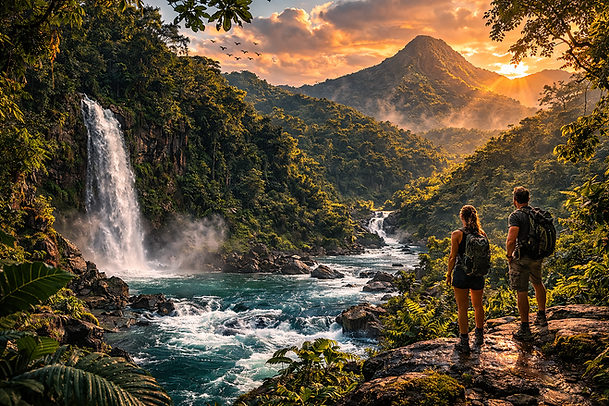
Discover why Dominica is considered the best hiking island in the Caribbean
Dominica, not to be confused with the Dominican Republic, is known as “The Nature Island of the Caribbean” and “The Land of 365 Rivers,” shorthand for how water and wilderness dominate the island’s identity. That isn’t just branding language. National Geographic reports that rainforests blanket roughly two-thirds of the island, and highlights how geothermal hot springs, waterfalls, and a dense network of trails make “get up and get moving” the default mode of travel here. What turns Dominica from “nice hiking add-on” into “best Caribbean island for hiking” is concentration and variety. In one trip you can link true rainforest trekking with highland ridges, crater lakes, and geothermal landscapes—without needing internal flights or long drives between disconnected regions. The island’s flagship backbone is the Waitukubuli National Trail, an official 184 km (115-mile) route divided into 14 segments that runs from Scott's Head in the south to Cabrits National Park in the north. Then there’s the island’s headline protected landscape: UNESCO recognizes Morne Trois Pitons National Park as a World Heritage Site, describing a rugged volcanic mountain range of steep volcanoes and deep canyons, with multiple live volcanic centers and a protected area spanning thousands of hectares. This is where Dominica’s hiking experience becomes uniquely sensory: steam vents, hot springs, crater lakes, and wet forests layered by elevation. It’s also where Dominica’s most famous trek leads: to Boiling Lake, reached by journeying through the Valley of Desolation—a landscape of minerals, hot springs, and fumaroles that feels more like a different planet than a “tropical island hike.” Signature Dominica hikes with waterfalls, lakes, and ridgelines Dominica has plenty of short nature walks, but the reason hikers fall in love is how quickly the island escalates into true adventure: muddy climbs, river crossings, cloud forest, and trail endings that feel earned. If you’re researching best Caribbean hikes and want the stories behind the search results, these are the experiences that make Dominica stand out. The island’s most iconic full-day trek is the Boiling Lake route. Dominica’s official tourism brochure describes the destination as the world’s second largest boiling lake and places it inside Morne Trois Pitons National Park. It also frames the approach as a roughly three-hour trail one way from Laudat, with the route moving from forest into higher, wind-shaped vegetation zones and then into the geothermal Valley of Desolation. The same brochure emphasizes key safety behavior: hikers should go with an experienced guide and stay on the trail in the Valley of Desolation because thin crust can conceal hot lava below. Complementing that, Dominica’s Forestry Division describes the approved access beginning near Titou Gorge and lists the Boiling Lake trail at roughly 2¾ miles (4.5 km) in-and-out via the same route (reflecting a specific trail segment definition rather than the full day’s cumulative terrain experience). If “hiking trails with waterfalls” is the reason you’re coming, Dominica can feel like a choose-your-own-adventure of cascades—some quick, some remote, some attached to serious mileage. The Forestry Division describes Trafalgar Falls as a very short access trail (0.2 km / 0.12 miles) leading to views of twin falls, while also noting hot pools along the stream and rainforest setting—an ideal “big reward for small effort” day that still photographs like a major expedition. At the other end of the effort spectrum is Middleham Falls, which the Ministry of Tourism notes sits at the end of a trail built through a large tract of tropical rainforest—an experience that’s less about a quick viewpoint and more about immersion in wet forest. For travelers searching “waterfall hikes near me” and realizing the answer might be “not near—tropical,” Dominica’s appeal is that even its most accessible waterfall-and-swim stops still feel like real forest. The Ministry of Tourism describes Emerald Pool as a ¾-mile loop trail and positions it as the most accessible trail in Morne Trois Pitons National Park—useful when you want a lighter day between bigger hikes or when you’re building hiking holidays that balance intensity. Dominica is also a true “lake island” by Caribbean standards, which matters if your ideal rainforest hiking tours include cooler high-elevation terrain. The Ministry of Tourism describes Freshwater Lake as the largest of Dominica’s four lakes, located at just over 2,500 feet above sea level, and notes it as a natural source of the Roseau River (with water use tied to electricity generation). Nearby, it describes Boeri Lake as the island’s second-largest lake, set around 2,800 feet elevation in a volcanic crater setting. Together, these hikes provide the “cooler mountains, misty forest, crater-lake energy” that many people assume they have to leave the Caribbean to find. Finally, Dominica’s hiking story isn’t only about Morne Trois Pitons. In the island’s north, the Forestry Division describes the Syndicate Nature Trail (within Morne Diablotin National Park) as a 1.4 km lasso trail with rainforest diversity, viewpoints, and the possibility of seeing Dominica’s endemic parrots—exactly the kind of “wildlife plus walk” day that makes Dominica feel uncrowded and intimate.
Explore Dominica with Wanderlust Caribbean
All-Inclusive Hiking & Multi-sport Adventure Travel Vacations


For travelers inspired by the incredible hiking found across Dominica, Wanderlust Caribbean offers a unique way to experience the island. Their approach combines all-inclusive adventure travel with boutique oceanfront accommodations, creating a seamless experience where every day brings a new exploration. Guests hike rainforest trails, discover waterfalls, and explore volcanic landscapes through daily guided adventures led by the owners or trusted local guides who know the island intimately. Trips are intentionally designed for small groups, allowing for a more personal atmosphere, flexible itineraries, and meaningful connection with Dominica’s landscapes and culture. With thoughtful planning, personalized attention, and consistently 5-star guest experiences, Wanderlust Caribbean has become known by many travelers as a hallmark of adventure travel in Dominica.
